

Still Water Does Not Lie | What the Lincoln Memorial Reflecting Pool Is Trying to Tell Us About Legacy, Family, and the Work We Keep Avoiding
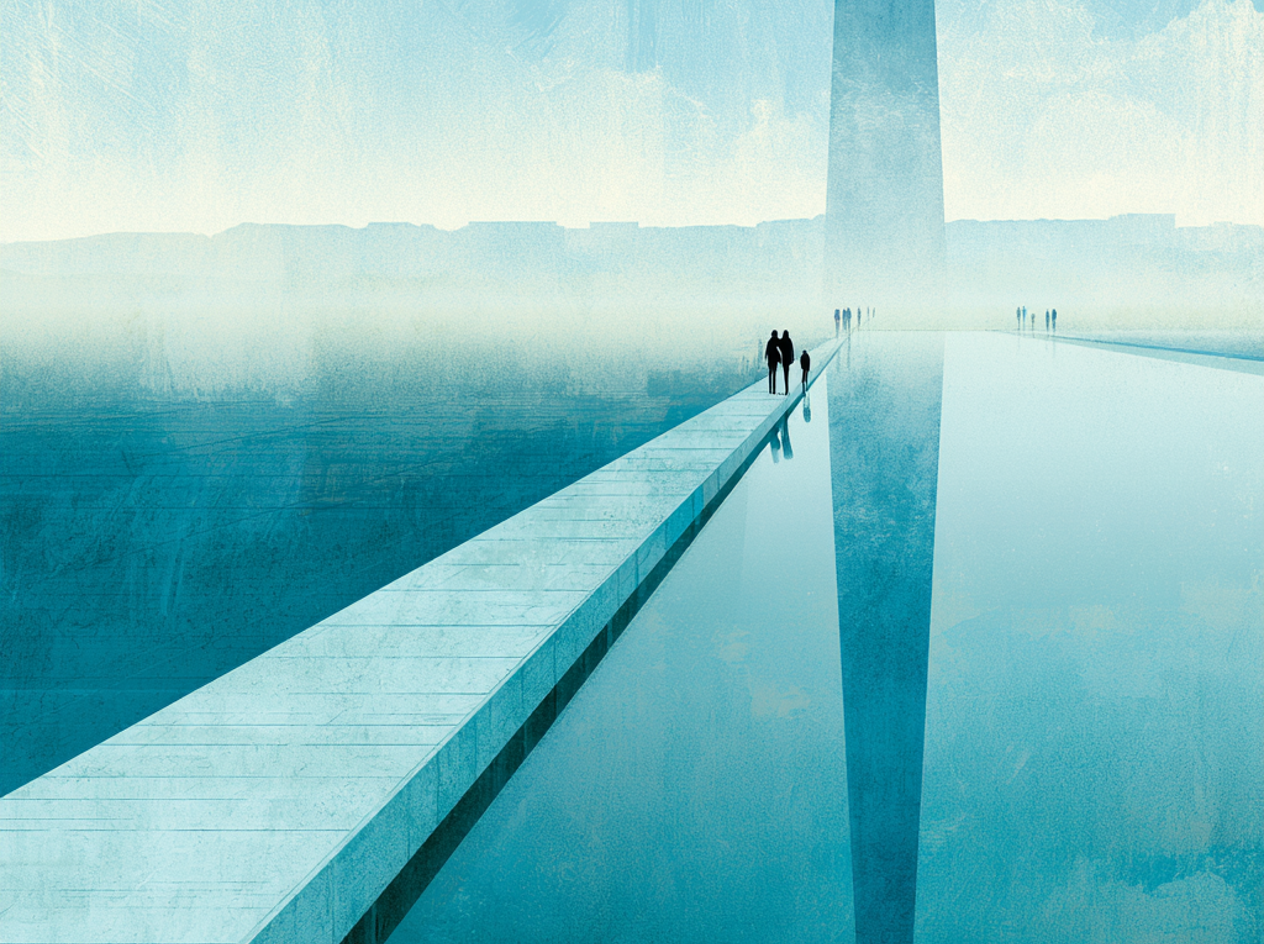
The Mirror
There is a body of water in the heart of this country that has been trying to get our attention for over a hundred years. It is a beautiful creation. Most everyday visitors pass it, snap a photo, and move on.
Architect Henry Bacon envisioned it as a seamless and uninterrupted water mirror - a long, shallow, still surface aligned exactly between the Lincoln Memorial and the Washington Monument so that both structures would appear doubled. The sky above and the reflection below. Two versions of the same truth, visible at once.
He was clear about the intention of his creation, “to introduce to the landscape an element of repose and beauty; “ to “add tranquility and retirement” to the memorial complex. A beautiful pause for us.
A reflecting pool is not built to be looked at. It is built to look into. So, Bacon specifically designed the floor to disappear - neutral, dark, invisible - so that the water could do what still water has always done. Reflect. The floor was designed to disappear. It would become the thing that refused to.
Still water has always served as a threshold - the place where the seen and the invisible meet. The book of James speaks of the person who looks in the mirror and walks away, immediately forgetting what they saw. The pool has always asked for something different. Not just a glance. A willingness to stay long enough to be changed by what you find.
The pool doesn’t try to reflect anything. Like a pond with the moon, it simply becomes still enough for the reflection to appear.
The invitation of a reflecting pool is simple - pause. Be still. Look at what is actually in front of you - and at what is within you, reflected back. That is it’s simple gift, albeit not always easy to receive because what the pool shows you depends entirely on whether or not you are willing to see.
The Lincoln Memorial Reflecting Pool was built in 1922 on land that was not solid ground. The site had been a tidal mosquito swamp - marshy, unstable, dredged from the Potomac River. The architects knew this. They drove more than 100 concrete pillars deep into bedrock to secure the Lincoln Memorial itself. For the pool, they made a different choice. No deep foundation. Just an asphalt and tile surface laid over soft river clay, filled with millions of gallons of water, and then opened to the public.
The pool began leaking almost immediately and over the decades sank nearly a foot into the ground. Repairs were made. A new concrete slab was poured directly on top of the old one. The added weight created more cracks. More repairs followed. The water turned. Algae bloomed. The pool was drained, cleaned, then drained again. Each generation of stewards inherited a problem that had been present since the beginning - and each responded from their own understanding of what it required.
The Lincoln Memorial Reflecting Pool is one of the most honest structures in this country - not just an aesthetic feature of the National Mall, but something that became much more. For over a hundred years, it became the place this country brought its unfinished business. Every march, every reckoning, every moment we needed to stand before something larger than ourselves and demand to be seen - we came to the water. The pool has always belonged to the people. Every administration is merely a temporary steward of what was never theirs to own.
For over 100 years, the pool has borne witness to the defining moments of this country.
Marian Anderson, denied a stage, sang to 75,000 people at that pool in 1939. In 1963, hundreds of thousands showed up for the March on Washington for civil and economic rights and lined the pool to witness Martin Luther King Jr. deliver ‘I Have a Dream’ - the most consequential speech of the civil rights movement. The pool grounds were the launching point for Anti-Vietnam protests in both 1967 and 1970. In 1968, following the assassination of Reverend Dr. Martin Luther King, Jr., thousands of demonstrators from the Poor People’s Campaign showed up to build an encampment known as Resurrection City.
In 1969, over half a million people gathered for the Second Vietnam Moratorium - the largest anti-war protest to date, at that time. In 2021, it served as a Covid-19 Memorial and held 400 lights lined alongside it - one for every 1000 Americans who died of the virus. The pool, in the heart of our country - an element of repose for protesters, mourners, marchers, dreamers; all coming to the water - to reflect.
For over a century, our country’s Lincoln Memorial Reflecting Pool has been asking the same question while simply being there. Beautiful. Still. Doing what it was built to do. In a world that moves at the speed ours does, stillness takes courage. But listening to what you see takes more. So many people never slow down enough to hear the question at all. Some do and look away. Some try to paint over it. But the question remains unchanged.
What do you actually see when you look?
The Question Every Steward Answers
Stewardship and ownership are not the same thing. We have often treated them as if they are - and it changes everything about how we tend to what we’ve been given.
The Lincoln Memorial Reflecting Pool has outlasted every person who has ever made a decision about it. It will outlast the ones making decisions about it now. That is the nature of what belongs to all of us - it does not arrive with any one steward and it does not leave with them either.
That is not a diminishment. On the contrary, stewardship is one of the most serious and profound responsibilities a person can hold. It also requires something that ownership does not.
It requires you to ask “What does this need?” versus “What do I want to do with it?”
Those are two very different questions - and the history of this pool is largely a story of which one was being asked.
The ground it was built on was unstable from the beginning. You cannot override a skipped foundation by managing what sits on top of it. The pool has demonstrated this, consistently, across a century.
What happened next is where the lesson sharpens.
For most of its first ninety years, the pool received what most inherited things receive - reactive maintenance. A patch here. A drain and refill there. New concrete poured on top of old concrete. The problem was handed forward, generation after generation, largely unchanged. Nobody asked what the pool needed. They managed what was visible and moved on.
Then came a steward who took it beneath the surface. The basin was rebuilt from the ground up. Thousands of pilings driven into soft river clay. The water source changed. The filtration rebuilt. The floor tinted neutral gray - not to be seen, but to disappear, so the reflection above it could be stronger.
Within weeks of reopening, algae bloomed across the surface.
Then came a steward who took it to the surface. The floor was painted vivid blue. The pool was drained.
The coating began to peel. Algae returned. The pool, days before the 250th anniversary of the country it was built to honor, went back behind fences.
Please hear me clearly. This is not a political story. It is a stewardship metaphor - about what we do with what we are given to tend.
The pool responded to both the same way - not with judgment, but with truth. Algae does not care about intention. Neither does inherited ground. The work continues regardless of who is tending and how. That is not a verdict. It is an invitation.
That is what a reflecting pool does. It cannot lie. It can only reflect.
Here is what the pool has been showing us - for anyone willing to look. A structure built on an unexamined foundation will require tending in every generation. Skipping the deep work at the beginning does not make it unnecessary. It makes it inherited. And when the people responsible for tending it respond to the surface symptoms without addressing the root, the symptoms return. Every time. In different forms. With increasing urgency.
We have watched this happen to the pool for a hundred years, and the question the pool keeps asking is not really about water or algae or paint. It is about what we are willing to do when something that belongs to all of us is struggling. Whether we will ask what it needs - or decide what we want it to look like. Whether we will do the unglamorous work of going beneath the surface, knowing it will not be visible when it is done, knowing the next steward may not acknowledge it - or whether we will manage the appearance and declare the work finished.
Stewardship requires a particular kind of humility. It asks you to hold something larger than yourself, tend to it for the time you are given, and hand it forward in better condition than you found it. The gift is not in the holding. It is in the handing forward - as a contribution to something that was never yours to own.
The pool has been waiting for that kind of tending for a very long time. So have most of the things worth tending.
The Ground Beneath the Family
Most families are built the same way - with shortcuts that were fully understood, and taken anyway.
Think about what gets handed down in a family. Not the things people intend to pass on – money, a house, the household rules, stated expectations, articulated values, the lessons they sit down to teach.
I’m referring to the unstated legacy - the household’s quiet undercurrent. The family’s unspoken dynamics. The subliminal inheritances that run the show. The way conflict is handled, or not handled. The rules about what can be said and what must never be said. The relationship to money, to authority, to need. The belief, never spoken but deeply encoded, about whether the people in this family are the kind of people things work out for.
Those things do not arrive with a label. They arrive as normal. As just how things are. As who we are. And most of them were not mistakes. They were survival strategies by the well-meaning - passed down by people who needed them to work, and they did. The family is here because of them. The problem is that survival strategies do not come with an expiration date. They keep running long after the conditions that required them have changed. The pattern is not wrong. It is running in the wrong season to a different audience.
And like the pool, the instability in a family system is often present long before anyone names it. The people who came before us were not indifferent. Most of them were doing the best they could - with what they knew, what they learned, and what they never got to examine. Many were operating from their own unprocessed inheritance. Overwhelmed. Running on patterns they never chose and never questioned. They built anyway. The pause is what is required. And most of us are never taught that.
We inherit that choice.
Here is the thing - not the idea that families are broken, but that families are patterned. The behaviors that cause us the most confusion in our adult lives are almost never original to us. They were encoded in a system that existed before we arrived. We absorbed them the way the pool absorbed the instability of the ground beneath it - not by choosing to, but by being built there.
And just like the pool, we spend years responding to symptoms without always understanding the source.
A family that treats conflict as danger will produce adults who flinch at disagreement -not because something is wrong with them, but because their nervous system learned that conflict meant something was about to break. A family where emotional needs were treated as inconvenient will produce adults who override their own instincts in relationships - not because they don’t have instincts, but because the system taught them that having needs was a problem.
That is not pathology. That is inheritance.
Every generation in a family is a temporary steward of what was handed to them. You did not choose what came before you. You did not design the original foundation. You are the one standing on it now and the question that matters - the only question that actually moves anything - is the same question the pool asks every administration that arrives to tend to it.
Are you going to address what is actually in the ground, or manage how the surface looks?
Some families do the surface work. They learn the words. They talk about boundaries, communication, healing. But the patterns beneath keep running at full speed. New vocabulary on top of old behavior is not progress. It just sounds like it. And for a while, it holds. Until it doesn’t. Until the cracks show through in a different form, in a different relationship, in the next generation.
Some families go beneath the surface. That work is not visible when it is done. It does not produce a moment. It does not come with an announcement. It looks like someone deciding to stop repeating a pattern they can finally see. It looks like a parent choosing to respond differently than their parent did, not because it is easy, but because they understand what they are handing forward if they don’t. It looks like someone doing the unglamorous, unwitnessed, unfinished work of tending what was given to them - knowing the ground may never be fully stable, knowing the work will continue past them, doing it anyway.
That is legacy work. Not the kind you frame and place on your desk. The kind that travels.
And here is what I know about families that begin to do this work: they do not become perfect. The ground is still what it is. But the people standing on it develop the capacity to see the ground for what it is, respond to it honestly, and tend to it with something closer to wisdom than autopilot.
The pool that received structural care - that had thousands of pilings driven into the soft clay beneath it, that had its circulation changed, its source water rerouted, its floor redesigned to serve the reflection above it - that pool still grew algae. The work did not eliminate every problem. It could not, because the original conditions were still present.
That pool was more itself than it had ever been. More capable of doing what it was built to do. More honest about what it needed next.
That is what happens in a family when someone decides to do the real work. Not perfection. Not the elimination of inherited patterns. Not a surface that finally looks the way it is supposed to look. The ground is still what it is. But when it has been seen honestly - the soft places acknowledged, the inherited patterns named, the shortcuts no longer pretended away - what gets built on top of it can actually be held. That is the foundation we are after. Not a perfect one. An honest one.
Your past is your present - until you make it conscious.
The work does not begin with fixing. It begins with seeing. The question is whether you are willing to stop moving long enough to look into still water and see what is actually there.
The One Standing at the Edge
We have talked about the pool. We have talked about the country and the family.
Now I want to talk about you.
Because every layer of this story - the national, the familial, the historical - eventually lands in the same place. It lands in the individual standing at the edge of the water, deciding whether to look.
You are a temporary steward too. Of your own patterns. Of your own inherited ground. Of the things that were handed to you before you were old enough to question them and that have been running quietly underneath every decision, every relationship, every moment you thought you were simply being yourself.
Most people spend their lives managing the surface of that. Keeping things looking functional. Maintaining the appearance of wholeness while the original cracks continue to widen underneath. Pouring new language, new relationships, new achievements on top of the old structure and calling it growth.
Growth requires you to look at what is actually in the ground. Anything else is just maintenance.
Here is what I have learned, after twenty years of doing this work with individuals and families and organizations: the moment a person becomes willing to stop managing how things look and start asking what is actually there is the moment everything becomes possible. Not easy. Not immediate. Not without the algae and the setbacks and the work that keeps revealing more work.
But possible in a way it was not before.
The pool does not ask you to fix what is in the ground in a single intervention. It never has. A hundred years of tending have not resolved the original instability - and the pool is still one of the most significant sites in this country. Still holding the reflections of what matters. Still asking the same question at the same depth.
What it asks is simpler than a fix. It asks you to be still. To stop filling the silence with noise, the emptiness with activity, the surface with paint. To become quiet enough that what is actually present can be seen. Not performed. Not managed. Seen.
That is the beginning of every real change I have ever witnessed. Not the loudest moment. The stillest one. The one where a person finally stops long enough to look into their own water and say - quietly, without drama, without anyone watching - I see it. I see what has been here all along.
That is not a small thing. In a world that moves at the speed ours does, stillness takes courage. But listening to what you see takes more. Saying I see the pattern - without immediately rushing to fix it, explain it away, or declare it resolved - that is the hardest and most important work there is.
The pool has been modeling it for us the entire time.
It sits in stillness. It holds what comes to it. It reflects faithfully - without pretending the ground beneath it is solid, without performing stability it doesn’t have. It simply keeps offering the surface. And keeps asking, to anyone willing to slow down enough to receive the question:
What do you see when you look into your own water?
What the Water Knows
This July 4th, the United States marks 250 years. It is a moment that invites exactly what a reflecting pool was always designed to offer - not a declaration of what has been built, but an honest look at what is actually there. What we have tended well. What we have handed forward. What we have painted over and called beautiful.
The pool has been there for over a hundred years. It has held the weight of this country’s most defining moments. It has received every administration, every intervention, every attempt to fix it, declare it, paint it, restore it. It has responded to all of them the same way.
With truth.
Not because it is wise. Not because it is trying. But because still water cannot do anything else. It simply receives what comes to it and shows what is actually there.
That is available to all of us.
Not the pool specifically. The practice. The willingness to stop moving long enough to become still. To look at what is actually in front of us - and at what is within us, reflected back. To listen to what we find rather than manage how it looks.
The pool is not broken. It never was. It has been doing exactly what it was built to do - faithfully, imperfectly, without opinion, without agenda.
So have the people who came before us. So are we.
The question has always been the same.
What do you see when you look - and are you willing to tend to it?
__________________________________
Lisane Basquiat is a Legacy Healing Strategist and the founder of the Shaping Freedom® methodology. If this piece opened something in you, that is the beginning - not the destination. The work of going beneath the surface is available to you.