
Your Second Act Starts Here | Why Your Worst Moment Might Be Your Best Teacher
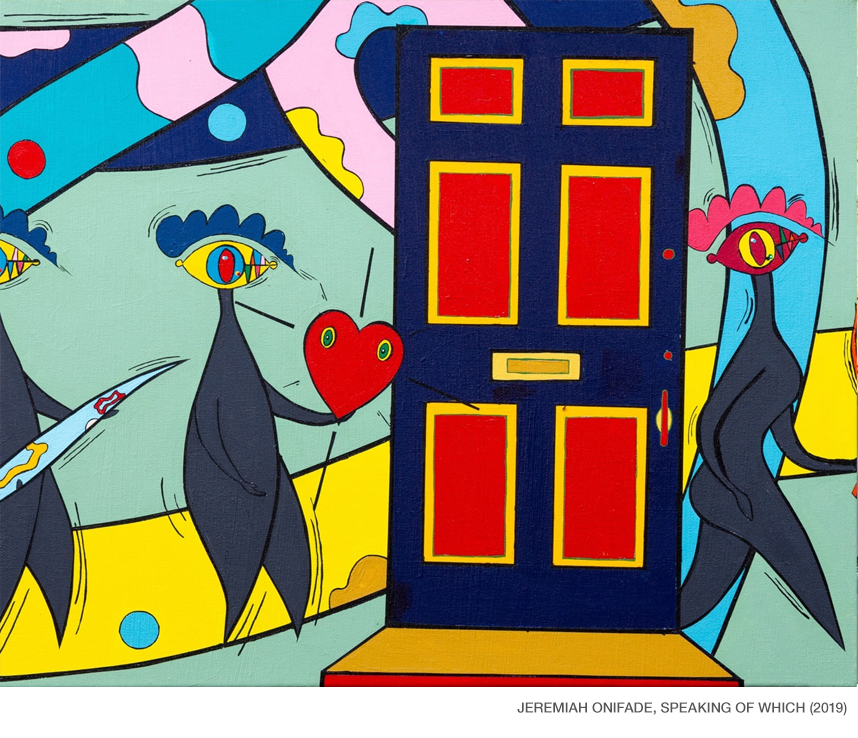
Artwork: Jeremiah Onifade, Speaking Of Which (2019)
At 13, Jeremiah Onifade watched his neighbors kill each other. A religious crisis in northern Nigeria turned his middle-class life into a memory overnight. His family fled with nothing but the clothes on their backs—no furniture, no belongings, no plan.
They moved to a house with no electricity for eight months. No running water. No paved roads. For eight months, they slept on concrete floors. No mattresses. No couches.
Most people would call that rock bottom. Jeremiah called it the beginning.
When I sat down with Jeremiah for the Shaping Freedom podcast, I wanted to understand how someone turns religious violence and poverty into a thriving art practice. What I discovered changed how I think about resilience, reinvention, and what it really takes to build something from nothing.
Here are three insights from our conversation that might just change how you see your own second act:
1. Survival instinct beats determination every time
Jeremiah and his younger brother didn't start a business because they were entrepreneurial. They started because they were hungry. Literally.
At 15 and 13, they hung out at a cyber cafe, waiting for people who needed help. Logo design? Jeremiah could draw it. Documents typed? His brother handled it. Payment came in internet access time plus whatever cash people would spare.
They'd take the money, leave, buy jollof rice with goat meat, eat, rest, then come back to finish the work. Within months, 50 people were lined up for their services.
It was about more than determination, Jeremiah told me. "It was survival instinct. We were hungry for food in our belly."
That hunger led him to save $50 to apply to art school in America. When he arrived at 21 with $200 in his pocket and half his tuition unpaid, he didn't know where he'd sleep that night. He dropped out after one summer and moved to Dallas, where he built an art practice from scratch—no degree, no connections, no roadmap.
2. Your vision is your canvas—dream big, then fill in the blanks
Jeremiah didn't have mentors or a typical path. What he had was a vision: create art that could mirror the experiences of people who'd survived what he survived.
Recently, for a confidence-building event, organizers asked him to create an interactive painting. He said no to canvases. He bought a boat instead.
"A boat refers to the journey," he explained. "A voyage of taking yourself from one point to another you haven't seen yet. You can only imagine it."
He'd never used a chainsaw before. Didn't know if the venue would allow it. But he showed up, cut the boat in front of the audience, and let people paint on the pieces—a promissory note to themselves about where they're headed.
The vision was the canvas. Then he figured out how to fill in the blanks.
3. Success is measured one step at a time
I asked Jeremiah how he measures success. His answer: "One step after the other. If I can successfully put the next step in front, that's it."
A man who slept on concrete for eight months, who arrived in America with $200 and no plan—he's not chasing accolades. He's grateful for every day his kids are healthy. Every day he can create.
"After I've been able to have a regular life outside what I used to live in after the riot, everything is a bonus."
That's not complacency. That's freedom. The kind that comes from knowing you've already survived the worst.
When I asked what he'd tell his 13-year-old self, he said: "You've discovered what other people couldn't. If you find yourself in that situation, congratulations—you've found something that's going to give you the strength to face life itself."
Your worst moment isn't the end of your story. It's the prologue to your second act. The vision is yours. The canvas is blank. And nobody else is going to create it for you.
TL;DR
Survival instinct beats determination every time. When you're literally hungry, creativity becomes necessity. Jeremiah and his brother built a business at 13 and 15—not from ambition, but from needing to eat. Real hustle comes from hunger, not inspiration.
Your vision is your canvas—dream big, then figure it out. Jeremiah bought a boat for an art project without knowing how to use a chainsaw or if the venue would allow it. The biggest dreams don't need permission—they need audacity and a willingness to learn as you go.
Success is one step at a time, not some distant finish line. After surviving displacement and sleeping on concrete, Jeremiah doesn't chase accolades—he's grateful for each day. When you've conquered the worst, everything else is just bonus points.
Learn More
Follow Jeremiah Onifade on Instagram: @jeremiaonifade for powerful Afro-surrealist installations that transform survival into visual storytelling.
Explore Jeremiah's work: Visit his portfolio to see how he gives emotions faces, turns displacement into art, and creates mirrors for people who need to see themselves surviving.