

Why Nothing Ever Resolves With Your Family | The words change. The pattern driving it never does.
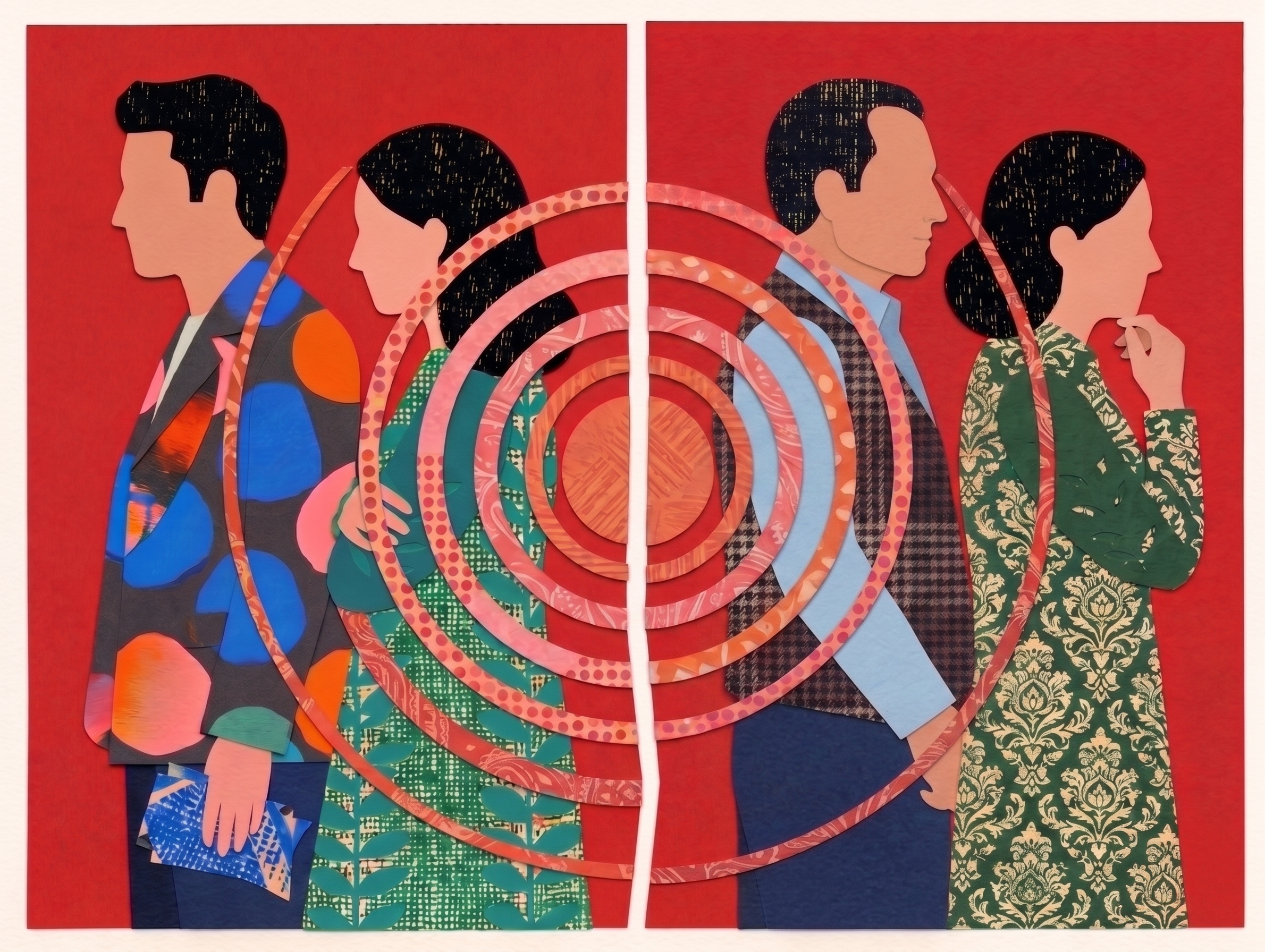
Why do you keep ending up in the same argument in your family?
The story may change from year to year but it is the same conflict, different topic. Maybe it's the silence that follows a conversation that you wish had gone differently. Maybe it's the look on a sibling's face that makes you feel diminished, like you're 10 years old, all over again.Or the tension you feel when certain subjects come up, like you're still arguing over something that happened decades ago.
You are not imagining it. There are patterns at play that may be running the show.
Almost 50% of US adults are currently estranged from someone they were once close to, according to The Harris Poll (2024). Most of them did not set out to get there. The distance built through repeated moments that never resolved — arguments that changed form but never changed their outcome.
1. The Argument Changes. The Pattern Running It Stays the Same.
Most people spend a lot of energy repeating the same arguments over different circumstances. The holiday plan. The comment that landed wrong. The decision one side made that the other couldn't accept.
What I've observed while working with families for over twenty years is this: The current "story" is rarely the problem. Its just another opportunity to argue about the same thing and to prove the other person wrong. Different topic to argue about. Same dynamic.
What I've seen in working with families for over twenty years is this: two people sit in the same moment and experience it completely differently. Each responds to what the moment means to them — not to what actually happened. Each walks away convinced the other person is the problem.
The argument changes. The dynamic stays the same.
The words may shift but each person's response stays consistent. The way a parent deflects or projects. The way an adult child goes silent in frustration; agreeing on the outside while simmering internally. The way one person shuts down as another grows more animated. The inauthenticity in the interaction because the real conversations aren't happening in the room.
Research tracking families over six years found that recurring conflict between parents and children systematically erodes a child's ability to navigate conflict in every relationship that follows. The encoded response becomes the default. In the family. At work. In their own relationships. (PMC, 2022) Patterns in families don't start with one event. They build strategies that both sides see but are unwilling to confront.
2. Where the Reaction Was Learned
Your nervous system is working as it is intended to.
Inside the family system you grew up in, there were rules. Not written rules. Rules about how conflict was handled. About what happened when someone expressed a need. About whether silence meant safety or danger. About who was allowed to be angry and who was expected to hold it together.
And because humans are so adaptable, those early rules became your default strategy for how you show up in relationships.
When someone close to you does something that registers as a threat — criticism, distance, rejection, silence — your nervous system doesn't pause to assess the situation. It runs the strategy it learned. The one that kept you safe inside a system that required it.
Research has tracked what happens when family conflict goes unnamed for years. The findings are hard to ignore. It registers in the body. It shapes the nervous system. And it shows up in the next generation. (Harold & Sellers, Journal of Child Psychology and Psychiatry, 2018). This is what I mean when I refer to how we bestow generational wealth from an emotional and mental wellness perspective
3. What Seeing the Pattern Changes
You cannot change what you are unwilling to see.
Most people spend years trying to change the argument — the tone, the timing, the words — without looking at what's driving it. The pattern underneath. The inherited emotional rules and strategies each side is responding to without realizing it.
Becoming aware of the pattern doesn't make it disappear but understanding it places you in a position to do something about it. To understand that what may feel like a personal attack could, in fact, help you to see something different within yourself.
Seeing how our patterns are playing out in our relationships, decisions, and circumstances is the critical first step to creating a different outcome for ourselves.
You may not be ready to hear this but - your parents have their own set of inherited patterns to deal with. They, too, came from a family that had its own set of rules, emotional ways of being, and strategies for existing within their family system. I mention that not to justify or condone the behaviors that caused you pain, but to show you that they can be the last person to bestow those patterns forward. This is an opportunity for you to choose a different path for your family, and to allow your parents to do their own work, or not.
The families I work with on the edge of estrangement aren't filled with bad people. They're filled with people running patterns they don’t see. Parents who genuinely don't understand why their children are so distant or what actually happened to get their family to the point that they are. Many genuinely did the best they knew how to do with what they, themselves, learned was the right thing to do. Adult children often struggle to speak their own language truth or to be heard. Both not wanting distance from each other but unaware of the patterns shaping the state of their relationship.
See the patterns. Change the outcome.
I'm running a live, two-hour Zoom session called Your Past Is Your Present: When Family Feels Distant, for parents and adult children who want to see what's actually driving the distance between them. If this resonates, I invite you to join me and save your spot, before the pattern shapes the outcome permanently.
TL;DR
The same family argument keeps happening because the pattern underneath it hasn't been seen. Two people can experience the same moment completely differently and both be telling the truth. Your nervous system learned its conflict strategy early — inside a family system that required it. Seeing the pattern doesn't mean assigning blame. It means understanding what each side is actually responding to. That's where different outcomes become possible.
Frequently Asked Questions
Why does my family keep having the same argument? Recurring family arguments happen because the conflict is being addressed at the surface level — the words, the tone, the specific grievance — rather than the pattern driving it. A pattern each person's nervous system learned early that now runs on auto-pilot. The pattern will continue, as designed, until someone becomes more aware of what is really going on - regardless of how much effort either side puts in.
What does it mean when family conflict feels personal? When a family argument feels deeply personal, its coming from more than this situation. Something in the interaction is hitting a pattern you learned early - about being heard, respected, or the value of your needs. It feels personal because its not only about what just happened.
Can family arguments lead to estrangement? Family estrangement almost never begins with a single event. It builds through repeated conflict that neither side can see clearly enough to name. Almost 50% of US adults are currently estranged from someone they were once close to, according toThe Harris Poll (2024). In most cases, the pattern that drove the estrangement was running long before it was addressed.
Why do I react so strongly to my parents even as an adult? Strong reactions to parents in adulthood are almost always rooted in learned patterns from early family systems. The nervous system encodes strategies for managing emotional experiences inside a family, and those strategies activate in situations that carry similar signals — regardless of age. The reaction isn't irrational. It's inherited.
What is a family conflict pattern? A family conflict pattern is a recurring dynamic in which two or more people respond to the same types of moments in predictable ways — often without realizing it. The topic of the argument changes. The roles each person plays and the outcome each side experiences stay the same. These patterns are typically encoded in childhood, inside the emotional rules of the family system each person grew up in.
Is it possible to break a pattern of recurring family conflict? Recurring family conflict can be interrupted, but behavior change alone rarely does it. The pattern has to be seen clearly before anything different becomes possible. Research tracking families over six years found that unaddressed recurring parent-child conflict erodes problem-solving ability across all relationships over time. (PMC, 2022) Seeing the origin of the pattern — what it is, where it came from, what each side is actually responding to — is what changes the trajectory.
–––––––
About Lisane Basquiat
Lisane Basquiat is the founder of Shaping Freedom and creator of the Your Past Is Your Present awareness session. A Board-Certified Master Practitioner of Neuro-Linguistic Programming and Certified Professional Coach with 20+ years guiding transformation, she helps people see the patterns shaping their responses so they can make more intentional choices. Her work is informed by cultural anthropology, neuroscience, and decades of experience working within family systems and leadership environments.